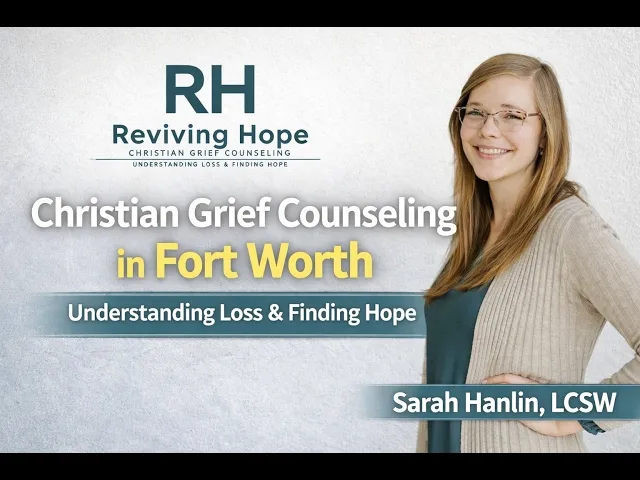

Grief Counseling in Fort Worth TX
You don’t have to be over it by now. Faith-integrated grief counseling in Fort Worth for adults and teens 13+, in person on Hulen Street or online across Texas.
Grief Counseling in Fort Worth TX
You don’t have to be over it by now. Faith-integrated grief counseling in Fort Worth for adults and teens 13+, in person on Hulen Street or online across Texas.
Grief Counseling in Fort Worth TX
You don’t have to be over it by now. Faith-integrated grief counseling in Fort Worth for adults and teens 13+, in person on Hulen Street or online across Texas.
The Reviving Hope Approach to Grief Counseling
When Loss Feels Too Heavy to Carry Alone
Grief has a way of showing up when you least expect it. One moment you're managing okay, and the next, you're overwhelmed by a wave of sadness so intense it takes your breath away. Maybe you lost a loved one unexpectedly to a heart attack. Maybe you're struggling to get through your daily responsibilities. Maybe you struggle with survivor guilt. Maybe holidays feel impossible now.
At Reviving Hope Christian Counseling, our licensed professionals understand that grief isn't something you "get over." It's something you learn to carry. Our grief counseling services for teens and adults create a space where you can be honest about how hard this is, where you can process the pain, and where you can figure out how to keep living while honoring the person you've lost.
Our Fort Worth office serves adult individuals and couples as well as teens 13+ throughout Fort Worth and surrounding communities such as Keller, Southlake, Benbrook, Aledo, and Arlington.
The Losses We Help People Carry
Grief doesn’t look the same from one loss to the next. The death of a spouse after forty years, a parent you were estranged from, a friend who died by suicide: each one asks something different of you, and each one gets misunderstood in its own way.
Sarah Hanlin, LCSW, works with people grieving:
Loss of a spouse or partner. Rebuilding a daily life that was built around two people.
Loss of a parent, including complicated relationships where grief is tangled with things that never got resolved.
Loss of a child, including miscarriage, stillbirth, and infant loss.
Sudden or traumatic death. Accidents, overdose, a death you witnessed or found.
Anticipatory grief. Grieving someone still living, through a terminal diagnosis or dementia.
Pet loss, which people apologize for and shouldn’t have to.
Non-death losses. Divorce, infertility, estrangement, a career or health you expected to have.
Whatever brought you here, you won’t have to justify why this one hurts.
The Overwhelming, Unpredictable Reality of Grief and Loss Counseling
If your grief feels overwhelming or comes in unpredictable waves, you're not alone. It's actually completely normal to feel like you're drowning in the grieving process. Grief & loss bring this impossible combination of crushing emotional pain while life keeps demanding you show up for work, take care of your family, pay your bills, and act like everything's fine.
Grief costs you sleep, focus, and the ability to make ordinary decisions, and it strains relationships right when you need them most. Those responses are normal, and Sarah walks through what is typical here.
How Long Will This Last?
There is no timeline, and grief does not end so much as it changes shape. The intensity shifts and the sharp edges soften, but there will always be a missing place where that person used to be. That is not a sign something is wrong with you. Sarah writes more about why grief is non-linear and why the five stages rarely play out in order in Understanding Grief: A Christian Counselor’s Guide to Navigating Loss.
What is Complicated Grief Therapy?
Most grief, as painful as it is, shifts and changes naturally over time. You learn to integrate the loss into your life. It still hurts, but it becomes part of your story rather than the only thing defining your days.
But sometimes grief gets stuck. Traumatic grief can have symptoms that go beyond normal grieving. You might have nightmares instead of comforting dreams about your loved one. You might have intrusive, horrible thoughts you can't shake. The pain might stay just as intense months or even years later, without any sense of it easing.
If that's your experience, you're dealing with what's called complicated grief or prolonged grief disorder, and it often needs specialized support to work through.
Grieving Deeply Without Losing Hope
Many Christians worry that deep grief signals weak faith. It doesn’t. Jesus wept at the grave of his friend, and Scripture tells us we grieve differently than those without hope, not that we grieve less. Sarah Hanlin, LCSW, unpacks this in Understanding Grief: A Christian Counselor’s Guide to Navigating Loss.
When Your Family Grieves Differently
One of the most frustrating parts of grief is watching the people closest to you process loss in completely different ways. Maybe your spouse wants to talk about it and you need space. Maybe your teenager seems fine one day and falls apart the next. Maybe you're crying and they're angry, or you're angry and they seem numb.
Different emotions of grief can feel lonely, especially when you desperately want to connect with people who understand this specific loss. But the reality is that everyone processes grief in their own way and on their own timeline.
When two people are grieving the same loss, they often can’t be each other’s therapist, and that isn’t a failure of the marriage. It’s just what deep grief does to capacity. We see couples together when the loss has put distance between you, and individually when you each need your own place to put it. For guidance on supporting someone who’s grieving, Sarah’s do’s and don’ts are here.
When to Consider Professional Grief Counseling
Grief and loss counseling can be helpful for anyone walking through loss, but it's not always necessary. Some people have strong support systems and find their own way through. But grief & loss completely changes how you see the world, affects every relationship in your life, and can even shake your faith. So having support from a mental health professional often makes a real difference.
You should really consider grief and loss counseling when grief is significantly impacting your quality of life. Examples of that are when you can't accomplish the basic responsibilities you need to handle, when you don't know how to navigate your relationships, or when you feel stuck.
If that's where you are, meeting with a mental health professional trained in grief therapy can give you tools, perspective, and support.
Getting Through Holidays, Anniversaries, and Triggers
Holidays and anniversaries hit differently when someone you love is missing. That empty chair at Thanksgiving. Their birthday without them. The first Christmas. These memories of the deceased create this gaping hole that nothing can fill, and the pain can feel as fresh as it did right after they died.
One of the most helpful things you can do is find ways to honor and remember your loved one during these difficult times. Light a candle in their memory. Leave an empty seat and talk about them. Make their favorite meal. Create new traditions that include remembering them.
One family we know created what they called an "Amy dinner" the first Christmas after losing their mom. Everyone brought dishes she loved, and they ate together and shared stories about her. It gave them permission to talk about her, to miss her out loud, and to keep her memory alive during a holiday that felt unbearably different without her.
There's no perfect way to get through these moments. But finding meaningful ways to remember your loved one helps. It keeps their memory alive and gives you and others space to grieve together. Bereavement counseling can offer this to you.
How Grief Work Moves in Session
A fear that comes up often: if the grief gets lighter, am I forgetting them? You aren’t. Sarah walks through that question in Understanding Grief: A Christian Counselor’s Guide to Navigating Loss.
What happens in session is building that carrying forward on purpose instead of hoping it happens on its own. Grief counseling gives you language for the relationship you still have with the person you lost, and a place to put the parts of the loss that have nowhere else to go.
Practically, the work moves between two things. Some sessions are about the loss itself: telling the story, sitting in what hurts, letting the parts you’ve been holding back finally surface. Other sessions are about the life you’re rebuilding around it: sleep, work, decisions you’ve been avoiding, relationships that have gone quiet. Most people need permission to move between them rather than stay in one.
When a death was sudden or traumatic, the memory itself can intrude before any of that grief work is possible. In those cases we may bring in EMDR so the intrusive images settle first, and you can grieve the person instead of reliving how they died.
Grief Counseling That Meets You Where You Are
At Reviving Hope Christian Counseling, we provide grief therapy that honors both your pain and your faith. We won't rush you, and we won't tell you to just pray harder or have more faith. We'll sit with you, give you individualized support, help you process the loss, and walk alongside you as you figure out how to keep living while carrying this grief.
Sarah Hanlin, LCSW, leads grief counseling at Reviving Hope for teens 13+ and adults. She brings both clinical training in grief and her own experience of loss, which is part of why she can sit with people in it without rushing them. Whether you’ve lost a spouse, a parent, a child, a close friend, or anyone who mattered deeply to you, she’s here to help you navigate this season.
We work with people experiencing normal grief and those dealing with complicated grief or traumatic loss. We understand that every loss is unique and every person grieves differently. There's no timeline we're trying to push you toward and no "right way" to grieve.
Do you offer Online Grief Counseling?
Absolutely! We offer telehealth grief counseling to those who find themselves struggling to process the loss. This can be helpful because grief can sometimes feel so overwhelming that it is just easier to do virtual counseling. All of our clinicians have had great experiences with individual sessions using online therapy.
You Don't Have to Carry This Alone
Grief is heavy. It's exhausting. It's overwhelming. And it can feel incredibly isolating, even when you're surrounded by people.
But you don't have to do this alone. Grief counseling provides support, understanding, and practical tools to help you work through loss while honoring the love you still carry for the person you've lost. It can be helpful to join a support group or go to group therapy to get the support you need for traumatic grief.
We're not here to make you move on or forget. We're here to help you navigate the overwhelming feelings, process what's happened, and learn how to carry your loved one forward as you figure out how to keep living.
If you're struggling with grief, whether it's been days, months, or years since your loss, we'd be honored to walk through this season with you. Our desire is that you would experience acceptance and healing. Especially if you are processing bereavement, please reach out for bereavement counseling.
Our therapists have specializations in Christian counseling, trauma, grief, addiction, porn addiction, sex addiction, anxiety, couples, sex and intimacy, and teens 13+. Check our blog page for more counseling content.
The Reviving Hope Approach to Grief Counseling
When Loss Feels Too Heavy to Carry Alone
Grief has a way of showing up when you least expect it. One moment you're managing okay, and the next, you're overwhelmed by a wave of sadness so intense it takes your breath away. Maybe you lost a loved one unexpectedly to a heart attack. Maybe you're struggling to get through your daily responsibilities. Maybe you struggle with survivor guilt. Maybe holidays feel impossible now.
At Reviving Hope Christian Counseling, our licensed professionals understand that grief isn't something you "get over." It's something you learn to carry. Our grief counseling services for teens and adults create a space where you can be honest about how hard this is, where you can process the pain, and where you can figure out how to keep living while honoring the person you've lost.
Our Fort Worth office serves adult individuals and couples as well as teens 13+ throughout Fort Worth and surrounding communities such as Keller, Southlake, Benbrook, Aledo, and Arlington.
The Losses We Help People Carry
Grief doesn’t look the same from one loss to the next. The death of a spouse after forty years, a parent you were estranged from, a friend who died by suicide: each one asks something different of you, and each one gets misunderstood in its own way.
Sarah Hanlin, LCSW, works with people grieving:
Loss of a spouse or partner. Rebuilding a daily life that was built around two people.
Loss of a parent, including complicated relationships where grief is tangled with things that never got resolved.
Loss of a child, including miscarriage, stillbirth, and infant loss.
Sudden or traumatic death. Accidents, overdose, a death you witnessed or found.
Anticipatory grief. Grieving someone still living, through a terminal diagnosis or dementia.
Pet loss, which people apologize for and shouldn’t have to.
Non-death losses. Divorce, infertility, estrangement, a career or health you expected to have.
Whatever brought you here, you won’t have to justify why this one hurts.
The Overwhelming, Unpredictable Reality of Grief and Loss Counseling
If your grief feels overwhelming or comes in unpredictable waves, you're not alone. It's actually completely normal to feel like you're drowning in the grieving process. Grief & loss bring this impossible combination of crushing emotional pain while life keeps demanding you show up for work, take care of your family, pay your bills, and act like everything's fine.
Grief costs you sleep, focus, and the ability to make ordinary decisions, and it strains relationships right when you need them most. Those responses are normal, and Sarah walks through what is typical here.
How Long Will This Last?
There is no timeline, and grief does not end so much as it changes shape. The intensity shifts and the sharp edges soften, but there will always be a missing place where that person used to be. That is not a sign something is wrong with you. Sarah writes more about why grief is non-linear and why the five stages rarely play out in order in Understanding Grief: A Christian Counselor’s Guide to Navigating Loss.
What is Complicated Grief Therapy?
Most grief, as painful as it is, shifts and changes naturally over time. You learn to integrate the loss into your life. It still hurts, but it becomes part of your story rather than the only thing defining your days.
But sometimes grief gets stuck. Traumatic grief can have symptoms that go beyond normal grieving. You might have nightmares instead of comforting dreams about your loved one. You might have intrusive, horrible thoughts you can't shake. The pain might stay just as intense months or even years later, without any sense of it easing.
If that's your experience, you're dealing with what's called complicated grief or prolonged grief disorder, and it often needs specialized support to work through.
Grieving Deeply Without Losing Hope
Many Christians worry that deep grief signals weak faith. It doesn’t. Jesus wept at the grave of his friend, and Scripture tells us we grieve differently than those without hope, not that we grieve less. Sarah Hanlin, LCSW, unpacks this in Understanding Grief: A Christian Counselor’s Guide to Navigating Loss.
When Your Family Grieves Differently
One of the most frustrating parts of grief is watching the people closest to you process loss in completely different ways. Maybe your spouse wants to talk about it and you need space. Maybe your teenager seems fine one day and falls apart the next. Maybe you're crying and they're angry, or you're angry and they seem numb.
Different emotions of grief can feel lonely, especially when you desperately want to connect with people who understand this specific loss. But the reality is that everyone processes grief in their own way and on their own timeline.
When two people are grieving the same loss, they often can’t be each other’s therapist, and that isn’t a failure of the marriage. It’s just what deep grief does to capacity. We see couples together when the loss has put distance between you, and individually when you each need your own place to put it. For guidance on supporting someone who’s grieving, Sarah’s do’s and don’ts are here.
When to Consider Professional Grief Counseling
Grief and loss counseling can be helpful for anyone walking through loss, but it's not always necessary. Some people have strong support systems and find their own way through. But grief & loss completely changes how you see the world, affects every relationship in your life, and can even shake your faith. So having support from a mental health professional often makes a real difference.
You should really consider grief and loss counseling when grief is significantly impacting your quality of life. Examples of that are when you can't accomplish the basic responsibilities you need to handle, when you don't know how to navigate your relationships, or when you feel stuck.
If that's where you are, meeting with a mental health professional trained in grief therapy can give you tools, perspective, and support.
Getting Through Holidays, Anniversaries, and Triggers
Holidays and anniversaries hit differently when someone you love is missing. That empty chair at Thanksgiving. Their birthday without them. The first Christmas. These memories of the deceased create this gaping hole that nothing can fill, and the pain can feel as fresh as it did right after they died.
One of the most helpful things you can do is find ways to honor and remember your loved one during these difficult times. Light a candle in their memory. Leave an empty seat and talk about them. Make their favorite meal. Create new traditions that include remembering them.
One family we know created what they called an "Amy dinner" the first Christmas after losing their mom. Everyone brought dishes she loved, and they ate together and shared stories about her. It gave them permission to talk about her, to miss her out loud, and to keep her memory alive during a holiday that felt unbearably different without her.
There's no perfect way to get through these moments. But finding meaningful ways to remember your loved one helps. It keeps their memory alive and gives you and others space to grieve together. Bereavement counseling can offer this to you.
How Grief Work Moves in Session
A fear that comes up often: if the grief gets lighter, am I forgetting them? You aren’t. Sarah walks through that question in Understanding Grief: A Christian Counselor’s Guide to Navigating Loss.
What happens in session is building that carrying forward on purpose instead of hoping it happens on its own. Grief counseling gives you language for the relationship you still have with the person you lost, and a place to put the parts of the loss that have nowhere else to go.
Practically, the work moves between two things. Some sessions are about the loss itself: telling the story, sitting in what hurts, letting the parts you’ve been holding back finally surface. Other sessions are about the life you’re rebuilding around it: sleep, work, decisions you’ve been avoiding, relationships that have gone quiet. Most people need permission to move between them rather than stay in one.
When a death was sudden or traumatic, the memory itself can intrude before any of that grief work is possible. In those cases we may bring in EMDR so the intrusive images settle first, and you can grieve the person instead of reliving how they died.
Grief Counseling That Meets You Where You Are
At Reviving Hope Christian Counseling, we provide grief therapy that honors both your pain and your faith. We won't rush you, and we won't tell you to just pray harder or have more faith. We'll sit with you, give you individualized support, help you process the loss, and walk alongside you as you figure out how to keep living while carrying this grief.
Sarah Hanlin, LCSW, leads grief counseling at Reviving Hope for teens 13+ and adults. She brings both clinical training in grief and her own experience of loss, which is part of why she can sit with people in it without rushing them. Whether you’ve lost a spouse, a parent, a child, a close friend, or anyone who mattered deeply to you, she’s here to help you navigate this season.
We work with people experiencing normal grief and those dealing with complicated grief or traumatic loss. We understand that every loss is unique and every person grieves differently. There's no timeline we're trying to push you toward and no "right way" to grieve.
Do you offer Online Grief Counseling?
Absolutely! We offer telehealth grief counseling to those who find themselves struggling to process the loss. This can be helpful because grief can sometimes feel so overwhelming that it is just easier to do virtual counseling. All of our clinicians have had great experiences with individual sessions using online therapy.
You Don't Have to Carry This Alone
Grief is heavy. It's exhausting. It's overwhelming. And it can feel incredibly isolating, even when you're surrounded by people.
But you don't have to do this alone. Grief counseling provides support, understanding, and practical tools to help you work through loss while honoring the love you still carry for the person you've lost. It can be helpful to join a support group or go to group therapy to get the support you need for traumatic grief.
We're not here to make you move on or forget. We're here to help you navigate the overwhelming feelings, process what's happened, and learn how to carry your loved one forward as you figure out how to keep living.
If you're struggling with grief, whether it's been days, months, or years since your loss, we'd be honored to walk through this season with you. Our desire is that you would experience acceptance and healing. Especially if you are processing bereavement, please reach out for bereavement counseling.
Our therapists have specializations in Christian counseling, trauma, grief, addiction, porn addiction, sex addiction, anxiety, couples, sex and intimacy, and teens 13+. Check our blog page for more counseling content.
The Reviving Hope Approach to Grief Counseling
When Loss Feels Too Heavy to Carry Alone
Grief has a way of showing up when you least expect it. One moment you're managing okay, and the next, you're overwhelmed by a wave of sadness so intense it takes your breath away. Maybe you lost a loved one unexpectedly to a heart attack. Maybe you're struggling to get through your daily responsibilities. Maybe you struggle with survivor guilt. Maybe holidays feel impossible now.
At Reviving Hope Christian Counseling, our licensed professionals understand that grief isn't something you "get over." It's something you learn to carry. Our grief counseling services for teens and adults create a space where you can be honest about how hard this is, where you can process the pain, and where you can figure out how to keep living while honoring the person you've lost.
Our Fort Worth office serves adult individuals and couples as well as teens 13+ throughout Fort Worth and surrounding communities such as Keller, Southlake, Benbrook, Aledo, and Arlington.
The Losses We Help People Carry
Grief doesn’t look the same from one loss to the next. The death of a spouse after forty years, a parent you were estranged from, a friend who died by suicide: each one asks something different of you, and each one gets misunderstood in its own way.
Sarah Hanlin, LCSW, works with people grieving:
Loss of a spouse or partner. Rebuilding a daily life that was built around two people.
Loss of a parent, including complicated relationships where grief is tangled with things that never got resolved.
Loss of a child, including miscarriage, stillbirth, and infant loss.
Sudden or traumatic death. Accidents, overdose, a death you witnessed or found.
Anticipatory grief. Grieving someone still living, through a terminal diagnosis or dementia.
Pet loss, which people apologize for and shouldn’t have to.
Non-death losses. Divorce, infertility, estrangement, a career or health you expected to have.
Whatever brought you here, you won’t have to justify why this one hurts.
The Overwhelming, Unpredictable Reality of Grief and Loss Counseling
If your grief feels overwhelming or comes in unpredictable waves, you're not alone. It's actually completely normal to feel like you're drowning in the grieving process. Grief & loss bring this impossible combination of crushing emotional pain while life keeps demanding you show up for work, take care of your family, pay your bills, and act like everything's fine.
Grief costs you sleep, focus, and the ability to make ordinary decisions, and it strains relationships right when you need them most. Those responses are normal, and Sarah walks through what is typical here.
How Long Will This Last?
There is no timeline, and grief does not end so much as it changes shape. The intensity shifts and the sharp edges soften, but there will always be a missing place where that person used to be. That is not a sign something is wrong with you. Sarah writes more about why grief is non-linear and why the five stages rarely play out in order in Understanding Grief: A Christian Counselor’s Guide to Navigating Loss.
What is Complicated Grief Therapy?
Most grief, as painful as it is, shifts and changes naturally over time. You learn to integrate the loss into your life. It still hurts, but it becomes part of your story rather than the only thing defining your days.
But sometimes grief gets stuck. Traumatic grief can have symptoms that go beyond normal grieving. You might have nightmares instead of comforting dreams about your loved one. You might have intrusive, horrible thoughts you can't shake. The pain might stay just as intense months or even years later, without any sense of it easing.
If that's your experience, you're dealing with what's called complicated grief or prolonged grief disorder, and it often needs specialized support to work through.
Grieving Deeply Without Losing Hope
Many Christians worry that deep grief signals weak faith. It doesn’t. Jesus wept at the grave of his friend, and Scripture tells us we grieve differently than those without hope, not that we grieve less. Sarah Hanlin, LCSW, unpacks this in Understanding Grief: A Christian Counselor’s Guide to Navigating Loss.
When Your Family Grieves Differently
One of the most frustrating parts of grief is watching the people closest to you process loss in completely different ways. Maybe your spouse wants to talk about it and you need space. Maybe your teenager seems fine one day and falls apart the next. Maybe you're crying and they're angry, or you're angry and they seem numb.
Different emotions of grief can feel lonely, especially when you desperately want to connect with people who understand this specific loss. But the reality is that everyone processes grief in their own way and on their own timeline.
When two people are grieving the same loss, they often can’t be each other’s therapist, and that isn’t a failure of the marriage. It’s just what deep grief does to capacity. We see couples together when the loss has put distance between you, and individually when you each need your own place to put it. For guidance on supporting someone who’s grieving, Sarah’s do’s and don’ts are here.
When to Consider Professional Grief Counseling
Grief and loss counseling can be helpful for anyone walking through loss, but it's not always necessary. Some people have strong support systems and find their own way through. But grief & loss completely changes how you see the world, affects every relationship in your life, and can even shake your faith. So having support from a mental health professional often makes a real difference.
You should really consider grief and loss counseling when grief is significantly impacting your quality of life. Examples of that are when you can't accomplish the basic responsibilities you need to handle, when you don't know how to navigate your relationships, or when you feel stuck.
If that's where you are, meeting with a mental health professional trained in grief therapy can give you tools, perspective, and support.
Getting Through Holidays, Anniversaries, and Triggers
Holidays and anniversaries hit differently when someone you love is missing. That empty chair at Thanksgiving. Their birthday without them. The first Christmas. These memories of the deceased create this gaping hole that nothing can fill, and the pain can feel as fresh as it did right after they died.
One of the most helpful things you can do is find ways to honor and remember your loved one during these difficult times. Light a candle in their memory. Leave an empty seat and talk about them. Make their favorite meal. Create new traditions that include remembering them.
One family we know created what they called an "Amy dinner" the first Christmas after losing their mom. Everyone brought dishes she loved, and they ate together and shared stories about her. It gave them permission to talk about her, to miss her out loud, and to keep her memory alive during a holiday that felt unbearably different without her.
There's no perfect way to get through these moments. But finding meaningful ways to remember your loved one helps. It keeps their memory alive and gives you and others space to grieve together. Bereavement counseling can offer this to you.
How Grief Work Moves in Session
A fear that comes up often: if the grief gets lighter, am I forgetting them? You aren’t. Sarah walks through that question in Understanding Grief: A Christian Counselor’s Guide to Navigating Loss.
What happens in session is building that carrying forward on purpose instead of hoping it happens on its own. Grief counseling gives you language for the relationship you still have with the person you lost, and a place to put the parts of the loss that have nowhere else to go.
Practically, the work moves between two things. Some sessions are about the loss itself: telling the story, sitting in what hurts, letting the parts you’ve been holding back finally surface. Other sessions are about the life you’re rebuilding around it: sleep, work, decisions you’ve been avoiding, relationships that have gone quiet. Most people need permission to move between them rather than stay in one.
When a death was sudden or traumatic, the memory itself can intrude before any of that grief work is possible. In those cases we may bring in EMDR so the intrusive images settle first, and you can grieve the person instead of reliving how they died.
Grief Counseling That Meets You Where You Are
At Reviving Hope Christian Counseling, we provide grief therapy that honors both your pain and your faith. We won't rush you, and we won't tell you to just pray harder or have more faith. We'll sit with you, give you individualized support, help you process the loss, and walk alongside you as you figure out how to keep living while carrying this grief.
Sarah Hanlin, LCSW, leads grief counseling at Reviving Hope for teens 13+ and adults. She brings both clinical training in grief and her own experience of loss, which is part of why she can sit with people in it without rushing them. Whether you’ve lost a spouse, a parent, a child, a close friend, or anyone who mattered deeply to you, she’s here to help you navigate this season.
We work with people experiencing normal grief and those dealing with complicated grief or traumatic loss. We understand that every loss is unique and every person grieves differently. There's no timeline we're trying to push you toward and no "right way" to grieve.
Do you offer Online Grief Counseling?
Absolutely! We offer telehealth grief counseling to those who find themselves struggling to process the loss. This can be helpful because grief can sometimes feel so overwhelming that it is just easier to do virtual counseling. All of our clinicians have had great experiences with individual sessions using online therapy.
You Don't Have to Carry This Alone
Grief is heavy. It's exhausting. It's overwhelming. And it can feel incredibly isolating, even when you're surrounded by people.
But you don't have to do this alone. Grief counseling provides support, understanding, and practical tools to help you work through loss while honoring the love you still carry for the person you've lost. It can be helpful to join a support group or go to group therapy to get the support you need for traumatic grief.
We're not here to make you move on or forget. We're here to help you navigate the overwhelming feelings, process what's happened, and learn how to carry your loved one forward as you figure out how to keep living.
If you're struggling with grief, whether it's been days, months, or years since your loss, we'd be honored to walk through this season with you. Our desire is that you would experience acceptance and healing. Especially if you are processing bereavement, please reach out for bereavement counseling.
Our therapists have specializations in Christian counseling, trauma, grief, addiction, porn addiction, sex addiction, anxiety, couples, sex and intimacy, and teens 13+. Check our blog page for more counseling content.
Meet Our Fort Worth Counseling Team
Every clinician at Reviving Hope integrates a biblical worldview with evidence-based clinical care.

Clifton Hickman
LPC, CSAT, EMDR, Gottman Level 3
Porn and Sex addiction, Addiction, Trauma and EMDR, Affair Recovery, Couples

Georgina Hickman
LPC, EMDR, CST Associate
Betrayal Trauma, Trauma, Anxiety, Couples, Sex and Intimacy Therapy

Sarah Hanlin
LCSW
Grief, Trauma, and Anxiety for Teens 13+ and Adults

Matthew Bacchus
LPC (TX and CO), SYMBIS, Gottman Level 1
Anxiety, Couples Counseling, Porn Addiction, Sex Addiction, Faith Struggles

Hope is alive
“And I am sure of this, that he who began a good work in you will bring it to completion at the day of Jesus Christ.”
Philippians 1:6 (ESV)
Hope is alive
“And I am sure of this, that he who began a good work in you will bring it to completion at the day of Jesus Christ.”
Philippians 1:6 (ESV)
© 2026 Reviving Hope Christian Counseling
© 2026 Reviving Hope Christian Counseling