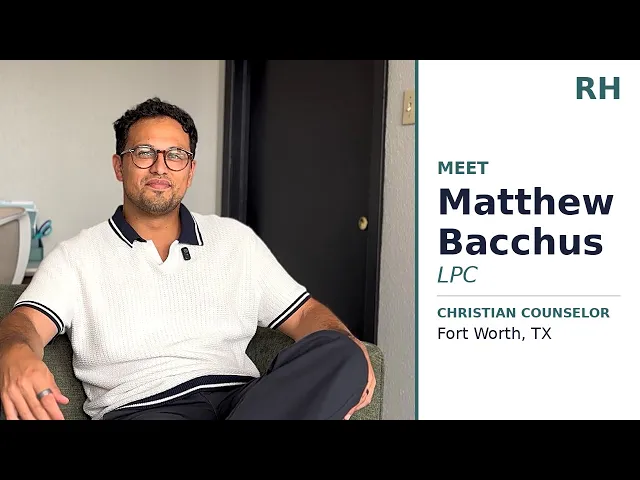
Meet Matthew Bacchus, LPC | Christian Counselor in Fort Worth
Matthew Bacchus, LPC, is a Christian counselor in Fort Worth offering porn and sex addiction counseling, SYMBIS premarital work, and couples therapy.
·
5 min read

Contributors

Clifton Hickman
Author
LPC, CSAT, EMDR, Gottman Level 3
Clifton Hickman has been a practicing therapist since 2020 and specializes in porn addiction, sex addiction, trauma, couples, infidelity, and addiction. He has been featured in Covenant Eyes, where he writes on pornography addiction and recovery. He also has a Foundations in Biblical Counseling from CCEF. As a co-founder of Reviving Hope Christian Counseling, he loves helping people find hope in the midst of their struggles. He is a father of two daughters and loves college football, reading, and movies.

Matthew Bacchus
Editor
LPC (TX and CO), SYMBIS, Gottman Level 1
Matthew Bacchus is a Licensed Professional Counselor specializing in anxiety, relationship issues, porn addiction, sex addiction, identity development, and Christian counseling. Drawing from cognitive behavioral therapy, psychodynamic and existential psychology, and attachment theory, he helps individuals and couples uncover the deeper beliefs and patterns that keep them feeling stuck. Matthew is passionate about bridging modern psychological research with timeless Christian wisdom, believing that genuine healing involves more than symptom reduction. It requires transformation of the mind, emotions, relationships, and character. Outside of counseling, Matthew enjoys spending time with family and friends, coaching track athletes, and training as a masters track athlete himself.
Matthew Bacchus joined Reviving Hope Christian Counseling in August 2026. He is a Licensed Professional Counselor in both Texas and Colorado and has been counseling since 2021. He works with couples, adults, and teens 16 and up, and he brings two areas to our practice that we did not have before: SYMBIS certified premarital counseling, and counseling for athletes and performers.
Below is Matthew in his own words, from a conversation we recorded shortly after he started.
Why Matthew Does Christian Counseling
Some counselors treat faith and clinical training as two separate toolkits. Matthew does not, which is the same conviction behind our approach to Christian counseling as a practice.
"I have a heart for it because I believe Christian counseling and biblical perspectives go hand in hand. We can actually have evidence-based psychology that goes alongside learning how to love God and accept God's love for us."
Asked how he has seen that play out, he pointed to clients who did not walk in as believers. (If you are wondering what that actually means in practice, we break down the differences between Christian, biblical, and nouthetic counseling in a separate article.)
"I've seen Jesus heal a lot of different wounds and aches, even from people who aren't believers, in sessions where they start to realize there is something bigger than themselves that they can work toward and become. It gives them more of a goal, more of a quest to go on. Because He loved us first, we can love others. Because God loves me, I can go love other people. I can even love myself better." (1 John 4:19)
Porn and Sex Addiction Counseling
Matthew is the second clinician on our team doing addiction work. He came to it the way most people who are good at it do, which is not academically.
"What drew me to porn and sex addiction work is seeing how pervasive it is in our culture and in our community, for men and women. It's a perversion of what God intended sexuality to be. And even just my own story with it, understanding that shame has a big foundation in a lot of this porn use and sex addiction."
That word, shame, is the center of how he works.
"If people can understand that porn and sex addiction is a symptom of something underneath, then I like to help my clients find the sources of shame so we can redirect, change the narrative, and bring God into that identity and into those stories. So a client can change the trajectory of their life and learn to manage the heaviness in a way that turns it back toward what God intended sexuality to be."
If shame as a driver rather than a consequence is new to you, Does God accept me as I am, or does He want me to change? covers the same ground from a different angle.
What Most Christian Men Get Wrong
We asked Matthew what men in the church most often misunderstand about why they keep going back.
"Mostly it's the 'this will never bother me again' mentality. And also that there's a certain procedure to get rid of this. Almost like, if I do this, then that will happen. But there's a lot of nuance to it."
The nuance, in his framing, is daily rather than one-time.
"That nuance is meant for a man to actually reexamine himself on a daily basis. Okay, where am I at? How are these external factors affecting me? How am I handling my emotions and my perspective on life? Instead of just breezing on by into a solution-focused perspective."
If You Have Already Tried the Filter, the Pastor, and the Confession
This is the situation Matthew sees most: a man who has done everything he was told to do and is still stuck.
"Those are great tools. But they're only surface level tools. They're not core tools."
What he does instead starts a layer down.
"What's different is learning to explore the root causes of certain behaviors. To understand why. To change the narrative around those behaviors, and to learn to cope in different ways rather than using porn or sex as a way of coping."
He also does something a lot of Christian men have never had a counselor do, which is refuse to treat their sexuality itself as the problem.
"I try to normalize that sex truly is a beautiful thing, and it's a normal thing. Sexual urges and desires are normal. And because they're normal, we can manage them. We have control over them. They don't control us."
For a fuller picture of how this work runs at our practice, see our porn addiction counseling page.
Porn Use at 17 and Porn Use at 35
Matthew sees teens 16 and up, which makes him the only clinician on our team who does both adolescent and addiction work. We asked whether the work is actually different.
"There's some overlap. There can be a lot of young curiosity even in an older person. But at 17 it's a little different in terms of naivety. With a full-on adult there's more habit breaking, more learning to do things differently, whereas it seems easier for a 17 year old to reroute themselves."
If you are a parent who has just found something on your son's phone, that is the practical difference. The pattern is younger and less set, and the work usually moves faster. Our teen counseling page covers how we handle the parent side of that.
When a Spouse Wants to Be in the Room
This question comes up early, and it deserves a straight answer, because two things are true at once.
The first is that individual therapy is confidential. Matthew's individual clients get an individual therapist, not a monitor.
"If it's helpful for the spouse to be in the room, that's only because it's going to help the client. Not as a chance for someone to be objectified or looked at or checked up on to make sure they're doing the right thing."
The second is that our practice does not keep secrets. Every client here signs a no-secrets policy. If something comes out in individual work that belongs to the marriage, an affair or ongoing acting out, that gets brought to the couple, either by the client or by the clinician. Confidentiality means Matthew is not reporting on your week to your wife. It does not mean he will help you hide.
When there is couples work running alongside, the goal is a conversation both people can survive.
"In couples counseling we learn how to talk about it, and how the betrayed spouse takes their own feelings into consideration without shaming the person who betrayed them."
If you are the spouse and you are the one carrying the discovery, that is its own injury and it deserves its own clinician. Betrayal trauma counseling at our practice is handled by Georgina Hickman.
Premarital Counseling and the SYMBIS Assessment
Matthew is a certified SYMBIS facilitator. SYMBIS stands for Saving Your Marriage Before It Starts, an assessment developed by Drs. Les and Leslie Parrott that each partner completes individually before the results are unpacked together in session.
"It's a psychological assessment that helps people preparing for marriage get prepared for marriage. What it really comes down to is learning how to have hard conversations before you get into marriage and get surprised by things you didn't know your future spouse does or is."
What SYMBIS Actually Opens Up
The assessment gets specific fast, which is the point.
"A SYMBIS certified counselor would discuss things like finances. How does your spouse handle finances? How do y'all handle finances? What was it like to see your parents' marriage, and how would that affect yours? From who does the dishes or who fixes the cars, all the way up to how often you each want to have sex."
He said the sections his clients tend to spend the most time on are the ones about individual wellbeing.
"How do I handle my partner's fears, or attachment issues, or abandonment issues? It really dives deep into that."
Honest Conversations Before the Wedding
Matthew is direct about what premarital counseling with him involves, including the part most couples do not expect.
"I'm not a therapist who dances around things. I want to get to practical ideas and practical thoughts, and at the same time hold room for people to explore the nuance of life. The fears that come with premarital counseling. The fear of 'I'm not sure if we should even get married.' There are times where I've had to tell clients, you should probably push back the wedding. We have a lot of things to work on. I'm not afraid to have those conversations."
That willingness costs something. A couple can leave that conversation upset and never come back. Matthew has decided that is a price worth paying, and it is one of the reasons we wanted him on this team.
Couples Counseling: Getting Back on the Same Team
Matthew is Gottman Level 1 trained and sees couples for ongoing marriage counseling as well as premarital work. His starting posture is not refereeing.
"What draws me to couples work is to not necessarily pick sides and say who's right or wrong or whose side I'm on. What draws me to it is to help them become a team again."
He named the misconception he runs into most.
"A lot of people get it wrong. 'Oh, we're going to go to counseling and the counselor is going to fix my spouse.' That's just not the case. It's mostly, how can we go against this cycle that we've started, and how do we change things moving forward?"
If you want more on how we approach marriage work as a practice, our couples counseling page covers the process, safety and no-secrets policy, and current rates. We also have a fuller explainer on what Christian marriage counseling actually involves.
Counseling for Athletes and Performers
This one is personal. Matthew is a former college track athlete who still trains as a masters athlete and coaches track.
"I wish I had someone I could talk to about performance issues in those areas. Tying my performance to my identity. Learning how to process bodily injuries alongside my emotional state."
The work is not about lowering the bar.
"I help athletes still uphold the standard of good performance and at the same time separate that from their value. You can have these feelings, and feelings are good, but truth is better. So we want to guide with truth. That's also where Jesus comes into play, because He says He is the way, the truth, and the life. I want to point my athletes to something bigger outside of track, football, volleyball, soccer, whatever it may be, and you can still perform well at the same time." (John 14:6)
Practically, he leans on narrative therapy to help an athlete rewrite the story they are living in.
"Learning how to rewrite my identity as an athlete who uses my talents for Jesus, not just to win. It's important and it's a responsibility to be a good athlete, to be a good teammate, to be coachable. Those things are just as important as asking why am I doing this. I'm doing this because God designed me for this." (Psalm 139:13-14)
He does not pretend the stakes are imaginary, especially for college athletes with money on the line.
"That's an okay thing to feel heavy about. The Lord gives and the Lord takes away. So what am I going to make peace with now? What is it I can still garner that serves the Lord?" (Job 1:21)
If You Have Been Hurt by the Church
We asked Matthew what he would say to someone who has been wounded by a church and is not sure a Christian counselor is a safe place to land.
"I don't blame them. That makes sense."
He does not treat that hesitation as something to argue a client out of.
"I'm not here to shame what happened to you, or what you did, regardless of what it is. I'm not here to say you're wrong for thinking a church treated you wrongly. That's unfair in so many aspects. I've been hurt by the church in so many ways, and it's actually kind of normal. They're humans too."
What he does push back on is avoidance, which is also where this work overlaps with trauma therapy and EMDR.
"Avoiding an issue is a symptom of things like PTSD. So we have to learn to go head in and embrace something, at least one small thing, so we can get where we want to be."
He also cited Irvin Yalom on why the room itself matters: psychotherapy is not a substitute for life but a dress rehearsal for life. Christian or not, the hurt travels with you and has to be worked somewhere.
And on whether he is a Christian counselor or a counselor who happens to be a Christian, Matthew is clear. He is a Christian therapist. His faith is not a credential he sets down when the session starts, and it is not something he will force on you either.
"Even though I'm a Christian, it's okay that it feels weird, and it's okay to voice that to me. That's totally fine."
If the question underneath yours is whether God is waiting on you to clean up first, that one has its own article: Does God accept me as I am, or does He want me to change?
What Matthew Wants You to Feel After the First Session
"I want them to feel hope. Hope in the sense that there is a problem and I can actually attack this problem. Not so much hope that all my problems are gone, because that's just not realistic. It's okay for the human experience to include problems, because that's what grows us."
Then he said the part that made us glad we hired him.
"If someone can leave at least one session with an amount of hope, it's that they are designed to be valued, and because of that value they are able to conquer problems. Whether they stay with me or another clinician, I hope that's what they gain."
That is close to the reason this practice has the name it has. Everyone is putting their hope in something. We want the people who walk through our doors to get a taste of the living hope of Christ, even in a session where His name never comes up.
Matthew's Credentials and Background
Licensed Professional Counselor, Texas (LPC #101075)
Licensed Professional Counselor, Colorado (LPC #0022108)
Certified SYMBIS Facilitator
Gottman Method Couples Therapy, Level 1
Counseling since 2021
Draws on CBT, psychodynamic and existential approaches, narrative therapy, and attachment theory
Former college track athlete, current masters track athlete and track coach
Who Matthew works with: couples, premarital couples, adult men and women, and teens 16 and up. Alongside couples work, he sees clients for anxiety and depression, grief and loss, life transitions, trauma, porn and sex addiction, church hurt and faith struggles, and performance issues for athletes. He is the second clinician on our team doing addiction work, and one of two who see teens.
Work With Matthew
Matthew sees clients in person at our office at 3509 Hulen St, Suite 255 in Fort Worth, Keller, or Arlington and by telehealth across Texas.
If you are engaged and want to do the work before the wedding rather than after, or you are an athlete carrying more than a training load, or you have been circling counseling for a while and are not sure a Christian counselor is safe, he is a good place to start.